A look at four key Manchester derbies over the decades, from the very first meeting over 140 years ago to (in)famous backheels, seven-goal thrillers and one particularly significant rout…
1881: the first meeting
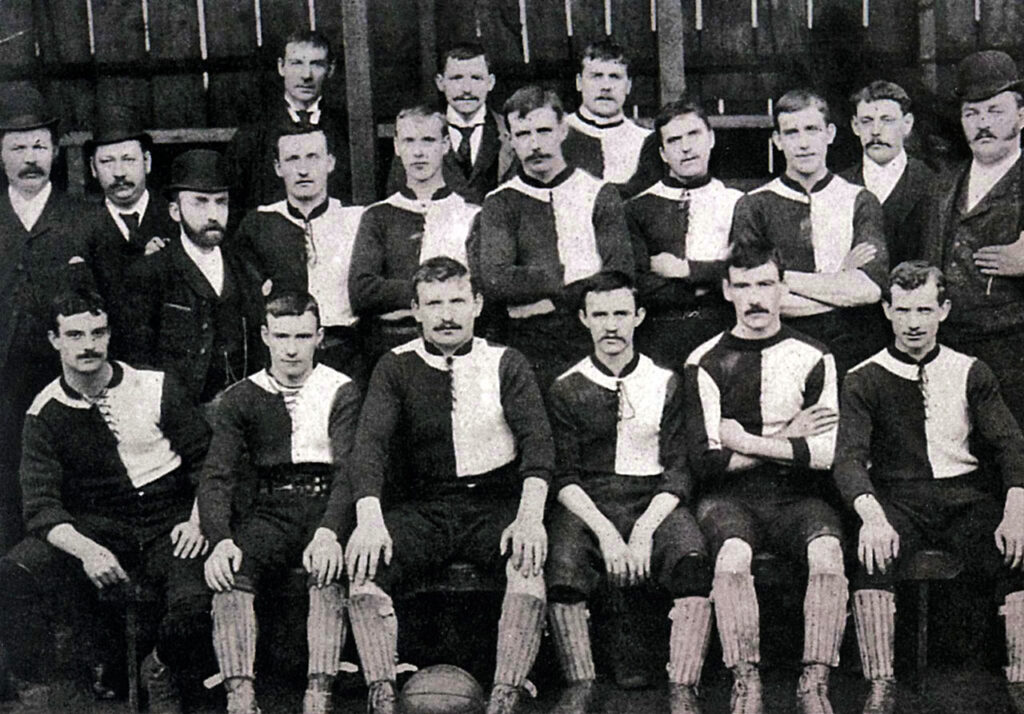
Technically, the first Manchester derby took place between two teams that did not bear the Manchester name, neither wearing what would become their trademark colours, played at a ground that is now a business park.
United’s origins are tied to the rail industry, with the Carriage and Wagon department of the Lancashire and Yorkshire Railway forming Newton Heath LYR in 1878. Their North Road ground was an unforgiving pitch, adjacent to the wagon works but owned by Manchester Cathedral authorities.
It became the site of the first ever ‘Manchester derby’ in 1881, when Newton Heath hosted St Mark’s, a club from West Gorton that had only been formed the previous year. In fact, the game took place almost one year to the day of West Gorton’s first recorded game, a 2-1 defeat to Macclesfield Baptists.
The hosts won 3-0 in what was described as “a pleasant game” by the Asthon Reporter. The game also bore witness to the first Manchester derby own goal: E. Thomas was the unfortunate St Mark’s player to put through his own net.
1974: that Denis Law backheel
It may be hard to believe now, but in April 1974, six years after lifting the European Cup, Manchester United were in dire straits, contemplating a first relegation of the post-war era.
In their penultimate game of the season, United had to beat their near neighbours City at Old Trafford to stand any chance of staying up. Leading the line for City that day was none other than Denis Law, previously part of United’s European Cup-winning side.
With nine minutes remaining and the game goalless, Law backheeled the ball beyond former teammate Alex Stepney. The crestfallen forward didn’t celebrate: his goal sparked a pitch invasion that delayed the game, but it was ultimately played to completion.
It led to the oft-repeated myth that the Lawman had relegated his old club, but in truth, United were going down anyway. Birmingham City’s win over Norwich City, and West Ham’s point against Liverpool, meant that the gap was insurmountable regardless. With relegation confirmed, United did have another game in hand, losing 1-0 at Stoke to round off a thoroughly miserable campaign.
2009: The seven-goal thriller
Arguably the greatest Manchester derby of all time, decided in United’s favour by a former Liverpool forward.
City’s big spending had started the previous season and continued apace, splashing out well clear of £100m on new recruits – including United striker Carlos Tevez – and beginning to challenge the established Premier League order.
Having won their first four games of the season, City made the short trip across Manchester to face the incumbent champions. The game that followed was a rip-roaring affair, with the visitors taking the lead on three occasions, only to be pegged back each time.
When Darren Fletcher scored his second and United’s third of the afternoon with ten minutes remaining, all three points were very much up for grabs. Then, in the 95th minute, Ryan Giggs found Michael Owen in space, and the substitute stabbed past Shay Given to send the home fans into raptures.
2011: The neighbours back up the noise
In the months following their Abu Dhabi takeover, Sir Alex dismissed City as “noisy neighbours”, and would repeat the remark on more than one occasion. But by 2011, the Citizens were becoming impossible to ignore, no matter how much Sir Alex increased the volume on his television.
By October that year, City had dropped just two points in eight games. They travelled to Old Trafford brimming with confidence, dismantling Sir Alex’s side with consummate ease.
The always controversial Mario Balotelli got on the scoresheet twice, famously unveiling his “Why Always Me?” shirt in celebration, and a third from Sergio Aguero with twenty minutes remaining put very clear daylight between the two teams. Darren Fletcher gave the remaining United fans a glimmer of hope nine minutes from time, only to see Edin Dzeko and David Silva turn it into a rout in the dying minutes.
A second from Dzeko added insult to grievous injury, inflicting United’s heaviest home defeat in over five decades.
City would go on to win the Premier League for the first time that year. Ferguson would win the last of his Premier League titles the following season before retiring. United have not won league silverware since, while their “noisy neighbours” have done so on seven more occasions.