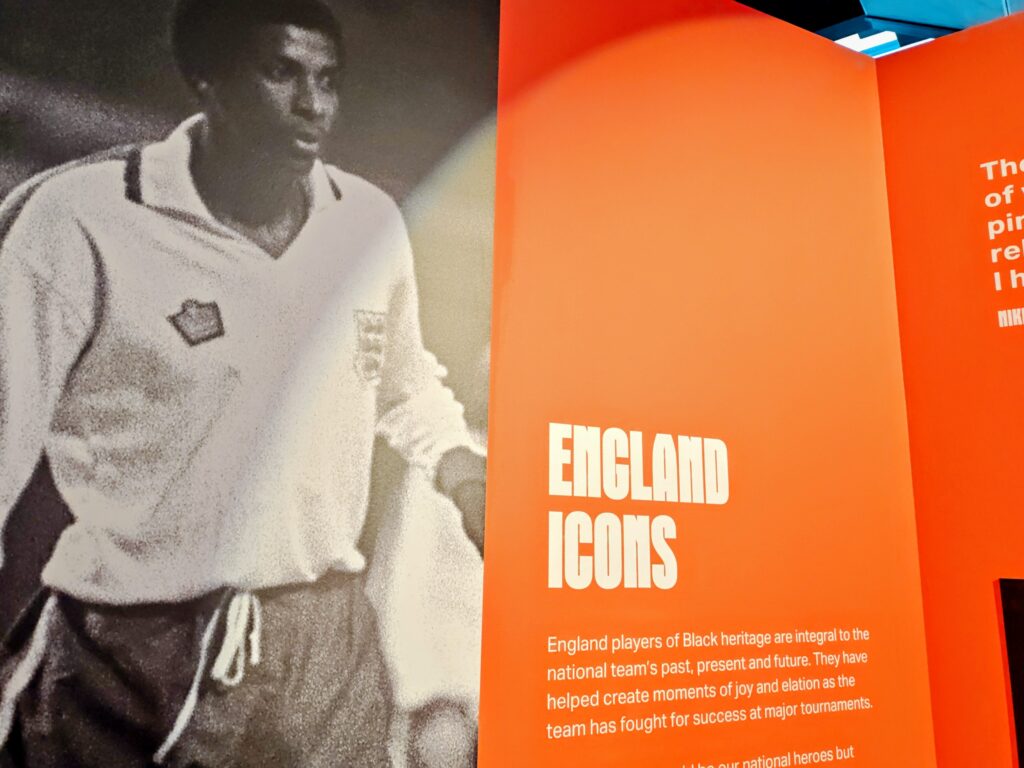
On 29 November 1978, on a freezing night at Wembley Stadium, history was made. It wasn’t much to do with the game itself, a friendly fixture against Czechoslovakia and the last international game of the calendar year. It wasn’t to do with the game’s only scorer either, Steve Coppell driving home from close range to defeat the European champions.
Instead, it was an unassuming right-back who made the headlines. 22-year-old Viv Anderson, a mainstay in Brian Clough’s title-winning Nottingham Forest side, made his senior international debut. In doing so, he became the first Black footballer to represent the Three Lions at senior level.
There were other players who proudly wore the Three Lions prior to this date. John Charles played – and scored – for our under-18s against Israel in 1962, while Benjamin Odeje represented England schoolboys in 1971. And one year prior to Viv’s senior debut, his future roommate Laurie Cunningham became the first Black player to play for England’s under-21s. He would receive his first cap six months after Viv.
The football landscape was markedly different in the late seventies. Unlike today, there were few Black players turning out for the country’s top clubs, and those who did were often subjected to racial abuse. Alongside Viv were West Bron trio Cunningham, Cyrille Regis and Brendon Batson, West Ham striker Clyde Best, and Wolves and QPR defender Bob Hazell.
The far-right, fascist National Front movement remained prominent and, a decade on from Enoch Powell’s infamous speech, racial discrimination was rife within society. Sadly, football was no different.
Viv had been subjected to that abuse from a shockingly young age. He was just eighteen years old when he was booed by Newcastle United fans as he warmed up on the touchline. Later that year, he was pelted with bananas by Carlisle United supporters. With his confidence understandably knocked, manager Brian Clough firmly insisted that he would be playing, stating that Viv could not allow racists to dictate his life.
Within four years of his debut, Anderson had become one of Clough’s go-to men in defence, and had both League and League Cup winner’s medals in his collection. Just 22 years old, he received a call-up to the England squad by Ron Greenwood. Despite his achievements, Viv was awed by some of the names in said squad. Kevin Keegan allayed any nerves, reassuring the full-back that he was there because he was good enough to be part of it.
Though he received his share of abuse around the country domestically, he enjoyed a rapturous reception when he stepped onto the Wembley turf. He kept a clean sheet on his debut, and went on to win another 29 caps for his country, scoring in a World Cup qualifier against Turkey in 1984, and again two years later in a Euro qualifier against Yugoslavia.
Regrettably, though he did feature once at Euro 1980, and was part of travelling squads in 1982 and 1986, Anderson never made a competitive appearance at a World Cup.
Domestically, he picked up back to back European Cup medals with Forest, featuring twice in the PFA’s Team of the Year, before enjoying a fine 1986-87 campaign with Arsenal, lifting the League Cup and getting into that PFA team a third time.
Approaching 40, he brought the curtain down on his career after a brief stint at Middlesbrough, 21 years after making his debut.
Football had changed considerably in the interim, with more Black players gracing the Premier League with their talent. By the time of Viv’s retirement, John Barnes, Ian Wright, Paul Ince, Andy Cole and Les Ferdinand (to name but a few) had all established themselves as superstars in their own right.
With that game against Czechoslovakia, Viv helped pave the way for entire generations to follow in his footsteps.