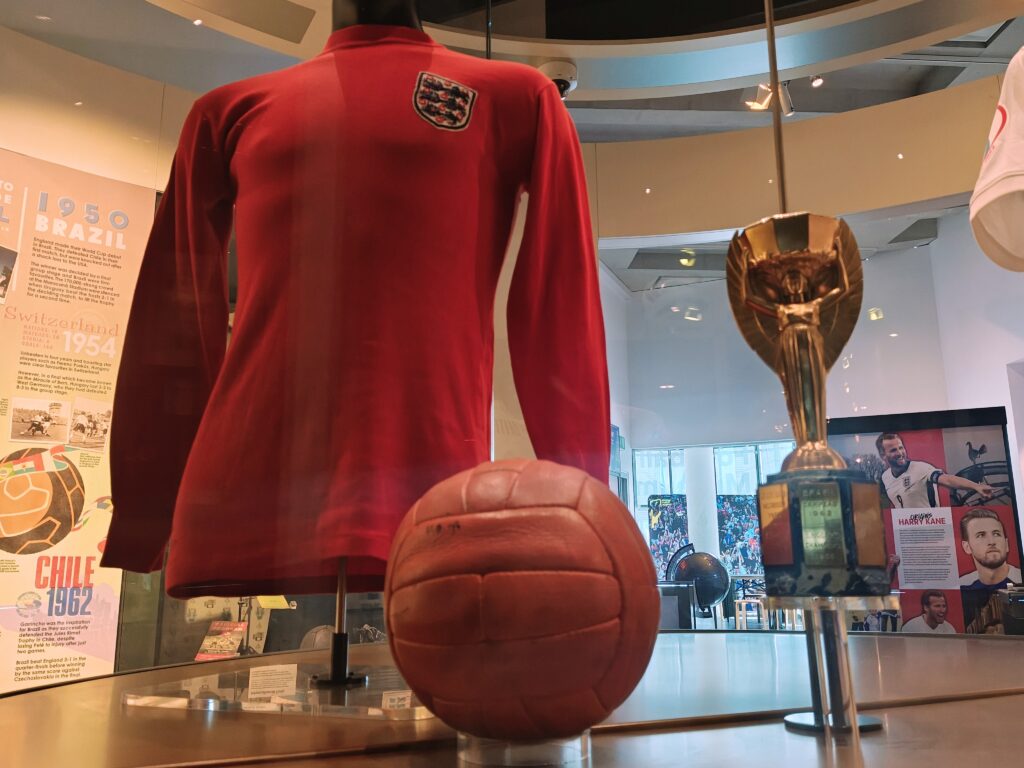
Sixty years ago, on a warm summer afternoon, over 32 million people across the country tuned in to see England win the FIFA World Cup for the first (and to date only) time.
The National Football Museum proudly tells the story of that triumph, through three remarkable objects from the final…
The Jules Rimet Trophy
The current FIFA World Cup trophy is not the tournament’s first. It is predated by the Jules Rimet Trophy, originally named victory but rechristened in honour of the former FIFA President.
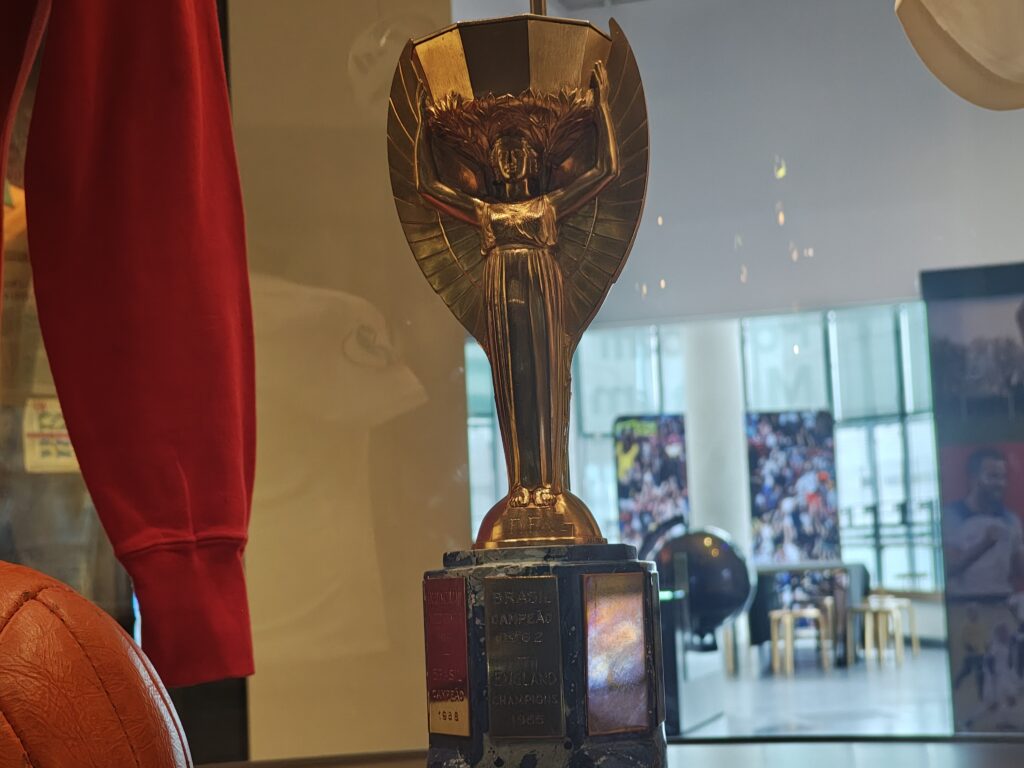
From 1930 to 1970, this trophy was awarded to the victors – but four months before the 1966 final, the trophy was stolen from a Westminster stamp exhibition. The episode soon descended into farce, with ransom notes, bungled meet-ups and panicking thieves.
The trophy was eventually found by Pickles the dog, placed into protection and eventually lifted by Bobby Moore – but the story doesn’t end there.
The FA had secretly commissioned a replica trophy, made by silversmith George Bird. In the dressing room after the initial celebrations, a plain clothes policeman quickly and quietly took the real McCoy from Nobby Stiles and handed the midfielder Bird’s replica.
In the celebrations and parades that followed, the facsimile was used, with the original safely under lock and key. In 1970, Brazil won the competition and, in keeping with the rules, kept the Jules Rimet outright. The FA’s copy was purportedly concealed under the bed of its creator!
In 1983, the Jules Rimet was stolen again, this time from the CBF’s headquarters in Rio de Janeiro. This time, it did not return.
As such, our remarkable replica – on loan courtesy of FIFA themselves – is as close as you can get to the real thing.
The 1966 Final match ball
Did you know that only one ball was used in the ’66 final – and it’s on display right here?
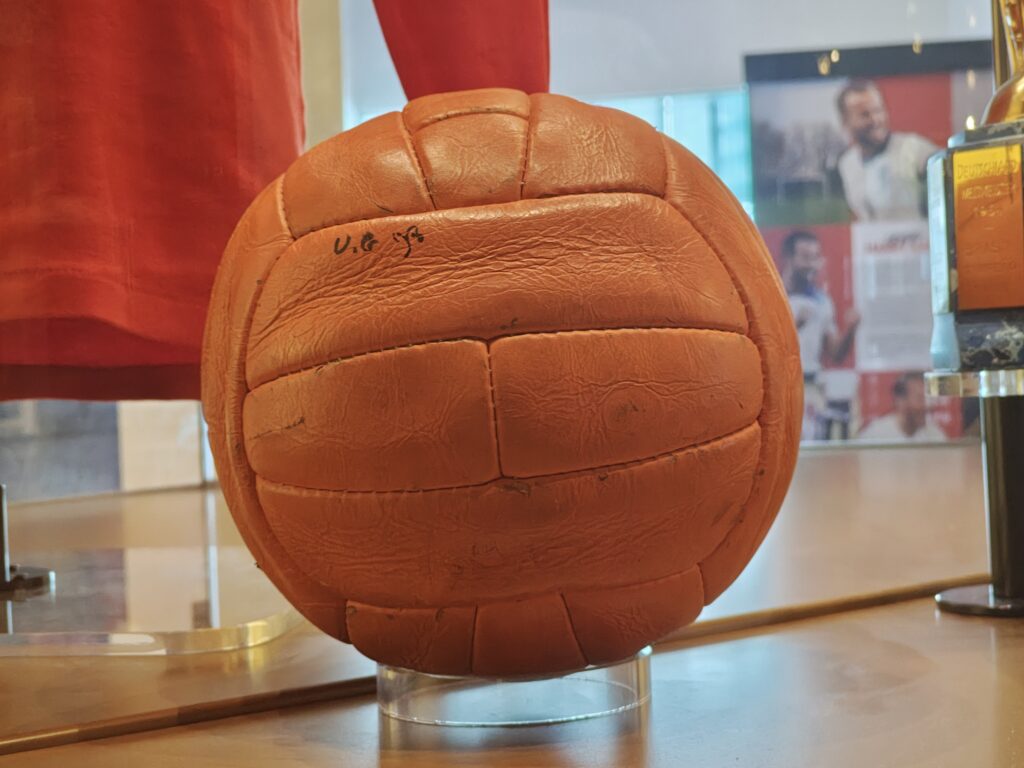
Of the 100 footballs inspected and scrutinised by The FA at their Soho headquarters, the Slazenger Challenge 4 Star was selected as the official match ball for the tournament.
Consisting of 25 leather panels, each ball was hand-stitched at Slazenger’s Horbury factory, three miles from Wakefield. Three different colours were manufactured – white, yellow and orange. The orange ball was chosen for the final, as it would be clearer for audiences to see on a black and white television screen.
While the trophy was stolen before the final, the match ball went missing afterwards. West Germany forward Helmut Haller took the ball home with him, citing a spurious German tradition of the game’s first goalscorer keeping the ball rather than, say, the scorer of a hat-trick.
Thirty years later, the ball was purchased by the Mirror Group, Virgin and Eurostar for £80,000 and repatriated ahead of Euro 96. During this period, the otherwise unblemished ball was signed by spoon-bending psychic Uri Geller, a move described as a portent of luck (but in reality a PR activation).
Thanks to CT scans undertaken by the University of Manchester, we know that the original rubber bladder has perished and degraded inside the ball, but the leather itself is still holding strong six decades on.
Sir Geoff Hurst’s shirt
Finally, we mentioned that in widely accepted football tradition, the scorer of a hat-trick gets to keep the match ball. This had never occurred in a World Cup Final prior to 1966, but Sir Geoff Hurst became the unlikely man to break that duck.
Incredibly, Hurst had only won his first England cap four months prior to the final, ironically against West Germany. He was on the bench throughout the group stage as Sir Alf Ramsey went with Jimmy Greaves and Roger Hunt as his attacking options.
However, Greaves – considered the finest striker in the country – suffered an injury against France, and Hurst duly capitalised on his absence. The West Ham striker scored the game’s only goal in a bad-tempered match against Argentina, then laid on one of Bobby Charlton’s goals in the 2-1 semi-final win over Portugal.
Though the press clamoured for Greaves’ return for the final, Ramsey selected Hurst again for the final – and was rewarded in the most dramatic way imaginable.
Hurst’s first goal was a leveller, heading home a Bobby Moore delivery. With the scores level at the final whistle, Hurst’s second came in extra time, a vicious shot that rattled off the crossbar ana just about crossing the line, according to linesman Tofiq Bahramov.
There was no disputing his third. In the dying embers of the game, Moore sent a long ball over the top for Hurst, who aimed to smash the ball into the stands to run down the clock, but instead found the roof of the net.
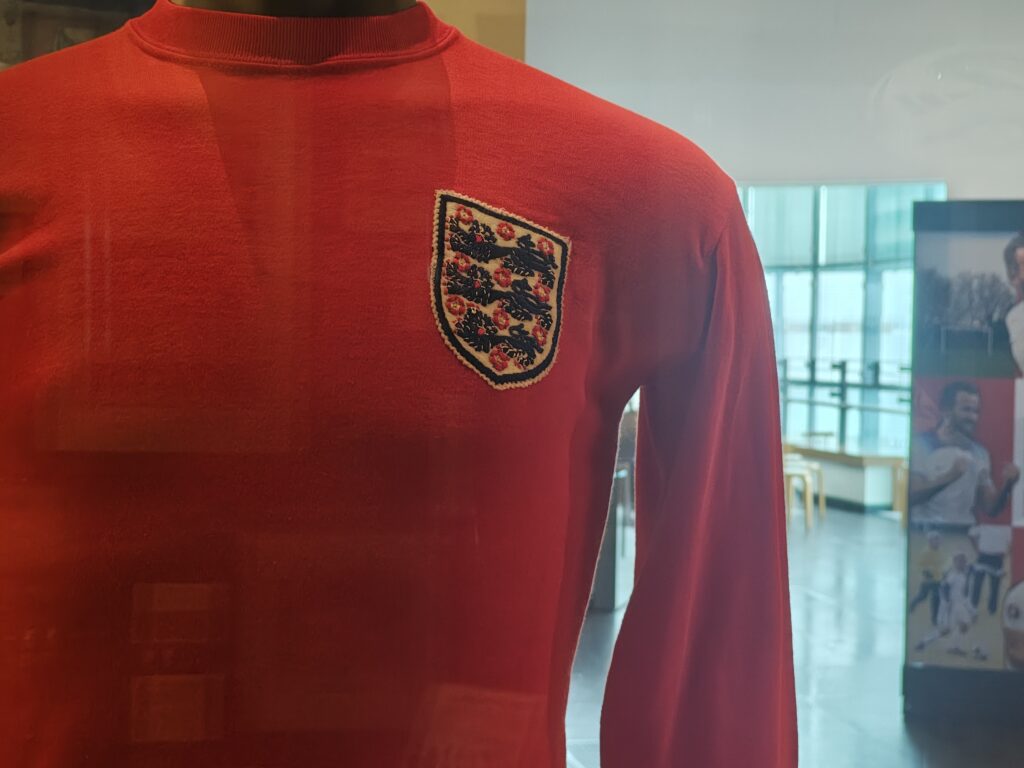
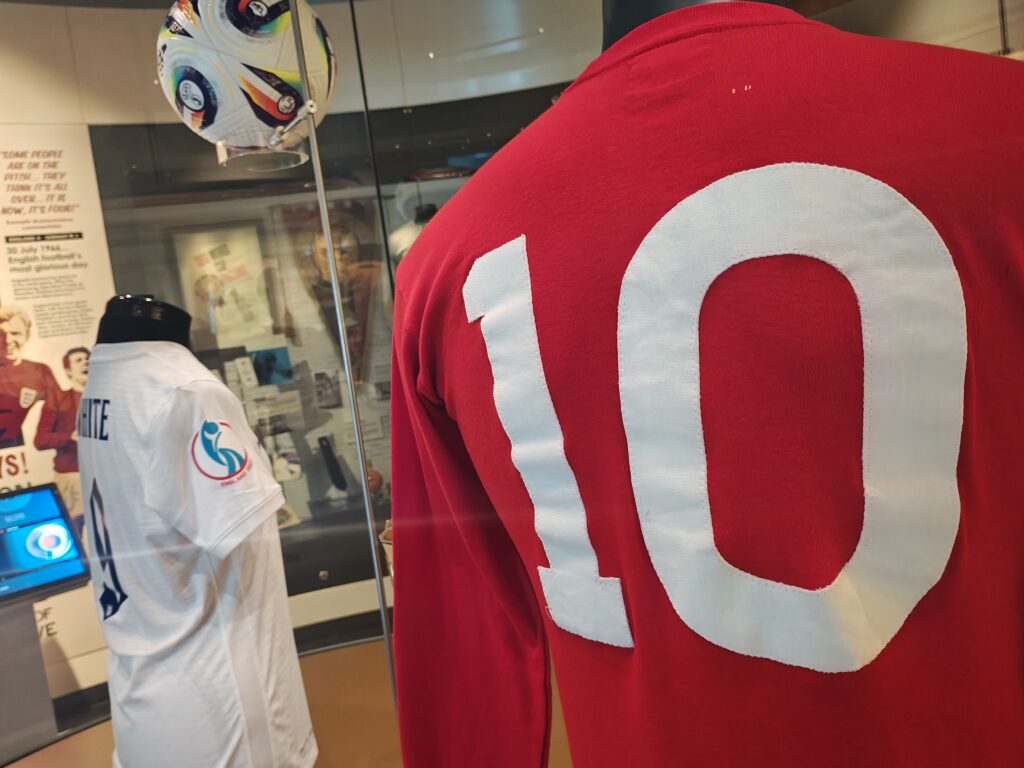
Hurst’s red number ten shirt is proudly on display here – but do you know why England wore their change kit for the final?
England exclusively wore white in the run-up to the Wembley showpiece, where they would eventually meet West Germany – another nation that traditionally plays in white. England lost the kit coin toss prior to the match, hence the now iconic red jerseys.